
Mandarin learning guide
Learn with 剛好遇見你
This guide focuses on how the lyrics move between shared memories, reflection, and longing. It is a useful song for learning everyday ways to express remembering, meeting again, and not wanting to part.
What to listen for
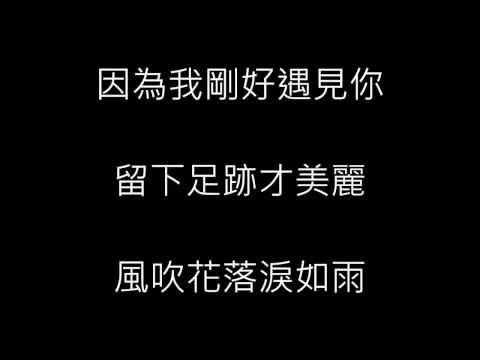
The lyrics look back on two people’s shared moments—crying, laughing, looking at the sky, and singing—before turning to the question of why the meeting mattered so much. Repeated lines about “刚好遇见你,” “留下足迹才美丽,” and “我想我会记得你” make the song especially useful for practicing emotional, reflective Mandarin in a simple and repeated structure.
- Recognize how the song links shared actions to later reflection.
- Use 因为 to explain a reason in a natural sentence.
- Understand several memorable lyric phrases that can be reused in everyday Mandarin.
How the song moves
Opening memories
The lyrics begin with shared past actions—crying and laughing—then widen to looking at the sky and singing together.
Reflective question
The song pauses on an open question about purpose, which shifts the mood from description to contemplation.
Refrain of meeting and parting
Repeated lines center on meeting by chance, not wanting to separate, and leaving traces or memories behind.
Closing wish
The final lines return to remembering the other person if they meet again.
Translation choices
我们哭了 我们笑著
- Natural English
- We cried, we laughed.
- Why
- This keeps the two short actions parallel and natural in English, matching the simple, repeated structure of the Chinese.
因为我刚好遇见你
- Natural English
- Because I just happened to meet you.
- Why
- “刚好” is best rendered as “just happened to” here, preserving the feeling of chance without sounding overly formal.
我想我会记得你
- Natural English
- I think I will remember you.
- Why
- “我想” works smoothly as “I think” in English, and “会记得” gives a clear future sense of lasting memory.
Useful Mandarin from the song
This is a very common word for something happening at the exact moment or happening by coincidence. It is useful in daily speech beyond songs.
Here it describes leaving something behind, especially a trace, memory, or result. It is widely used with concrete and abstract nouns.
This is a very common expression for desire or reluctance. In the lyric it shows a strong wish to avoid parting.
A basic but important verb for memory and recollection. In the song it expresses a lasting impression, and it is widely usable in everyday Mandarin.
Listen closely
- Notice how the repeated opening pattern helps you catch the contrast between happy and sad moments: 哭了, 笑著.
- Listen for the shift from description to reflection when the line 到底是为了什么 appears.
- Pay attention to the repeated refrain lines about meeting, footprints, and not wanting to separate; they anchor the song’s emotional center.
Check your understanding
Which line gives the song’s main reason for the meeting and uses 因为?
Show answer
因为我刚好遇见你。
In 留下十年的期许, what does 留下 mean in this context?
Show answer
It means “leave behind.”